


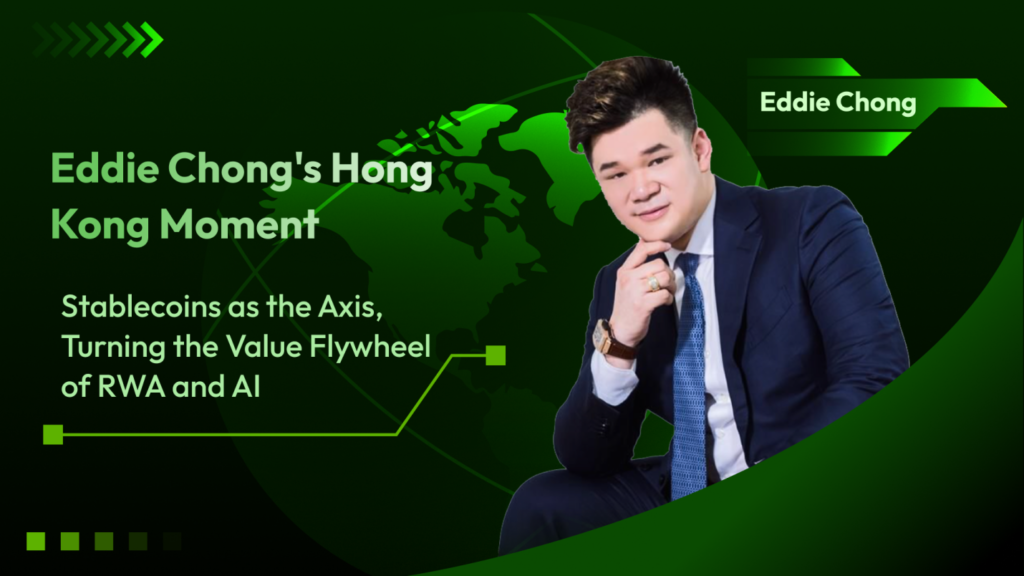
April marked a defining acceleration in Hong Kong’s emergence as a global hub for regulated digital assets, as the city rapidly advanced its Web3 compliance architecture. On April 10, the Hong Kong Monetary Authority (HKMA) issued its first batch of stablecoin issuer licenses, with leading financial institutions such as Standard Chartered-backed “Anchor” and HSBC among the early approvals from a competitive pool of 36 applicants. Shortly after, on April 19, the Securities and Futures Commission (SFC) expanded the regulatory framework further by allowing tokenized authorized investment products to be traded on licensed virtual asset platforms in secondary markets.
These coordinated policy moves signaled a structural shift rather than incremental reform—they laid the groundwork for a regulated, institution-ready digital asset ecosystem. For Eddie Chong, Chairman of the SFI (Stable Coin Infrastructure) Ecosystem Foundation, this moment represents the long-prepared alignment between policy clarity and infrastructure maturity. His core thesis—using stablecoins as the settlement backbone to unlock real-world assets (RWA) and enable AI-driven financial systems—has now moved firmly into execution.
Building Infrastructure Before Demand Arrives
Eddie Chong’s approach to Web3 has consistently been defined by anticipation rather than reaction. As Chairman of SFI, founder of X Infinity, and Executive Chairman of HK Web3 Club, he operates across a global ecosystem spanning Asia, Europe, and the Americas, with influence extending across more than 100 companies and a large-scale entrepreneurial network.
Instead of following cycles, he builds foundational layers that the industry eventually depends on.
After entering Bitcoin in 2015, he quickly identified scalability limitations that restricted real-world payment adoption. This led him to establish X Infinity, a blockchain infrastructure initiative focused on performance and scalability. During the 2019–2020 downturn, he strategically shifted toward real-world asset tokenization, anticipating that blockchain’s long-term viability would depend on integrating physical and digital economies.
That early positioning has grown into a $5 billion RWA portfolio spanning more than 400 investments. By 2026, he co-founded SFI with a clear mandate: solve the structural bottlenecks in RWA adoption—specifically liquidity and compliant access pathways—without which tokenized assets cannot achieve financial utility.
SFI: A Connected Ecosystem for Continuous Value Flow
SFI is structured as a multi-layer infrastructure network rather than a standalone platform. Its purpose is to unify stablecoins, RWA markets, AI systems, and real-world consumption into a continuous value circulation loop.
At its foundation is Solulu Club, providing liquidity infrastructure with over 200,000 active users and strong transactional depth. Built around it are five interconnected modules:
- Solulu Pay, enabling compliant fiat and crypto payment rails that connect traditional finance with Web3 ecosystems.
- Caviar, a luxury commerce platform enabling real-world spending using stablecoins.
- COPX DAO, using AI-driven quantitative systems to optimize trading strategies and liquidity efficiency.
- RWA Incubator, supporting compliant asset tokenization and institutional onboarding.
- RWA Exchange, enabling secondary market trading and price discovery for tokenized assets.
Together, SFI, COPX DAO, and Caviar form the “Iron Triangle”—a self-reinforcing system where infrastructure, value creation, and consumption continuously amplify one another. Stablecoins serve as the central settlement layer connecting the entire ecosystem.
Hong Kong’s Regulatory Shift as a Structural Catalyst
For years, RWA adoption was limited by two fundamental constraints: lack of compliant entry infrastructure and insufficient liquidity mechanisms. Hong Kong’s April regulatory expansion addressed both simultaneously.
Stablecoin licensing introduced clear legal foundations for issuance and circulation, while secondary market authorization for tokenized products enabled real liquidity formation for digital assets. This positioned Hong Kong as one of the most advanced regulated Web3 jurisdictions globally.
SFI leveraged this shift by actively participating in the Hong Kong Web3 Festival, showcasing a fully integrated ecosystem spanning payments, tokenization, trading, and real-world consumption.
During industry discussions, Chong emphasized a core structural issue: tokenization alone does not create functional value. Without users and liquidity, assets remain inactive. He highlighted SFI’s key advantage—an existing user base combined with real consumption channels that transform stablecoins into usable financial instruments.
At the same time, SFI continues expanding its global compliance footprint, holding regulatory approvals in the United States and Canada, with ongoing progress in the UAE and Hong Kong. This framework is designed not only for internal scaling but also as reusable infrastructure for broader industry adoption.
The Next Phase: AI and RWA Convergence
Chong views the current RWA expansion as only the initial stage of a larger systemic shift. The next phase will be defined by deep convergence between real-world assets and artificial intelligence.
On-chain RWA assets have already exceeded $25 billion, with projections pointing toward multi-trillion-dollar scale by 2030. Meanwhile, AI systems are evolving from analytical tools into autonomous economic agents capable of executing transactions and managing capital flows.
He sees this convergence as inevitable: RWA provides real-world value backing, while AI provides the intelligence layer required to activate and optimize it at scale.
Within SFI, this integration is already operational. COPX DAO applies AI models for automated trading strategies including arbitrage, hedging, and yield optimization. Meanwhile, AI-driven analytics generate real-time pricing signals based on market dynamics, asset fundamentals, and sentiment data—addressing long-standing inefficiencies in valuation and liquidity discovery.
Chong’s framework remains consistent: compliance forms the foundation, stablecoins act as the axis, AI functions as the engine, and RWA serves as the fuel. Together, they create a continuously self-reinforcing financial flywheel.
From Concept to Operating System
Eddie Chong’s trajectory reflects a consistent philosophy: build early, build foundationally, and build where structural gaps exist.
With SFI, that philosophy is evolving into a functioning ecosystem that integrates financial infrastructure, AI systems, and real-world economic activity. Hong Kong’s regulatory acceleration has acted as a catalyst, but long-term success will depend on scalable infrastructure capable of sustaining liquidity, compliance, and adoption across cycles.
As stablecoins, RWA, and AI continue to converge, the value flywheel Chong envisioned is no longer theoretical. It is becoming an operational system—designed for continuous, real-world economic value creation at scale.
Follow SFI and ecosystem partners:
- SoluluPay: https://x.com/SoluluClub_web3
- Caviar: https://x.com/shopcaviar
- COPX DAO: https://x.com/Copx_DAO
Related links:
https://hackernoon.com/preview/69dd93f363a00fd65ee51d8f
https://www.me.news/contents/273131
https://www.techub.news/articleDetail/9ecd8c5e-616d-41bf-9da2-c0a99e918ddf
